
Oxygen Built the First Bioeconomy. Feedstock Will Build the Next.
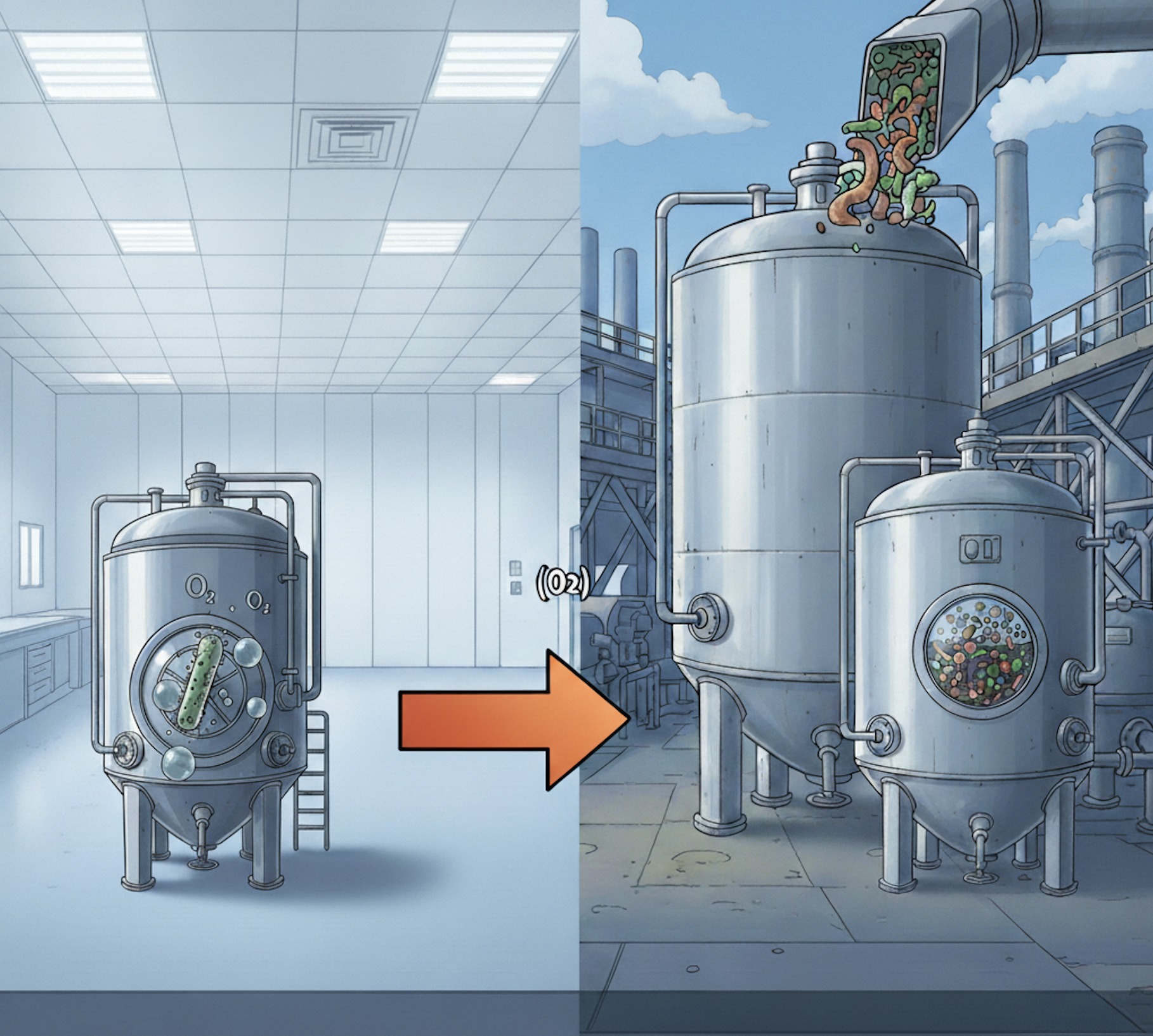
GLP-1 and other blockbuster biologics remind us that microbes power modern industry. But the infrastructure that scaled insulin and monoclonal antibodies was built around a specific biological assumption: abundant oxygen, purified carbon, and sterility.
That assumption shaped everything: reactor design, capital allocation, and scale-up logic.
It may not define the next era of the bioeconomy.
The Yield Optimization Era
Industrial biotechnology was built on oxygen and refined sugars to maximize cellular yields and stirred tank reactors that made the submerged process operationally controllable. Pharmaceutical hardware evolved around this productivity model and became the dominant framework for scale-up equipment, innovation roadmaps, and capital allocation. But control comes at a cost.
Maintaining sterility and continuous oxygenation requires significant energy and capital that scale non-linearly with reactor size. Concentrated sugars add stability but demand purity and sterility. Oxygen maximizes yield but requires intensive mixing and aeration. Continuous oxygen transfer is one of the most energy- and capital-intensive operations at industrial scale. Yet even with that investment, poor air distribution can still limit growth rate and yield. In order to make the economics of using pharma-inherited models work in the circular economy, synthetic biology aims at optimizing genomes to maximize yield before scaling. But the physics of mixing intensity, and mass transfer coefficients still set a ceiling on productivity at scale, regardless of genomic elegance and efficiency achieved on the bench.
For therapeutics, the productivity ceiling might be acceptable because product margins absorb this cost. But in commodity bioeconomy it isn’t, and often shatters hopes of what once looked promising in a flask.
The overlooked infrastructure of robust biology
While industrial bioeconomy maximized productivity in monocultures with pure feedstocks, another biological infrastructure scaled in parallel, optimizing robustness. The waste-processing industry operates at volumes that pharmaceutical bioreactors have never approached. They run without sterile conditions, without refined sugars, and without continuous oxygenation. Instead of single strains, they rely on resilient microbial communities capable of handling heterogeneous inputs.
This is already the largest deployed biological processing network in the world.
Some of these anaerobic processes have already evolved to capture value. For example, anaerobic digesters are deployed at scale to produce renewable energy in the form of methane gas, used as fuel. Anaerobic digestion alone processes millions of tons of organic material annually, converting waste into methane at industrial scale. These systems were built for waste stabilization and energy recovery but they demonstrate something critical: that large-scale biology can operate without oxygen or refined sugar.
Anaerobic processes also naturally accumulate carbon intermediates (organic acids) that can anchor new value chains. While the infrastructure to build new value chains beyond methane exists, the question is how it will be directed.
The Feedstock Intelligence Era
While using crops as feedstock has shifted a step away from pure sugars, those streams are finite, and already heavily allocated. Corn ethanol already consumes a significant share of crop production, yet meets only a fraction of emerging fuel demand.
As carbon supply becomes a limiting factor, organic waste can expand the manufacturing capacity of the bioeconomy value chain and reduce reliance on crops as feedstock, with potential for sustainability value-driven revenue. But unlike the standardized nature of media with sugar or glycerol used in aerobic pharmaceutical processes, and crops as homogeneous and seasonally predictable feedstock, waste is heterogeneous and variable.
In waste-based value chains, feedstock composition drives the biochemical pathways the anaerobic microbial community takes, determining product distribution, yield stability, and downstream upgrading economics. Its composition shifts with season, climate, supply chains, and human behavior. In a waste-derived bioeconomy, variability becomes the governing variable. Without feedstock intelligence, scale-up models are built on averages and assumptions rather than data, locking in invisible risk.
The physics of oxygen defined the limits of productivity in the Yield Optimization Era.
The information embedded in feedstock variability will define the limits of productivity in the next.
If the bioeconomy shifts toward waste-derived carbon, then understanding, predicting, and strategically routing heterogeneous inputs becomes infrastructure.
Building the next generation of bioindustry requires a new layer of control.
Feedstock intelligence.
