
A tale of two biologies
One in the lab, one in the field. We’ve spent decades optimizing one and bending the other to fit it.
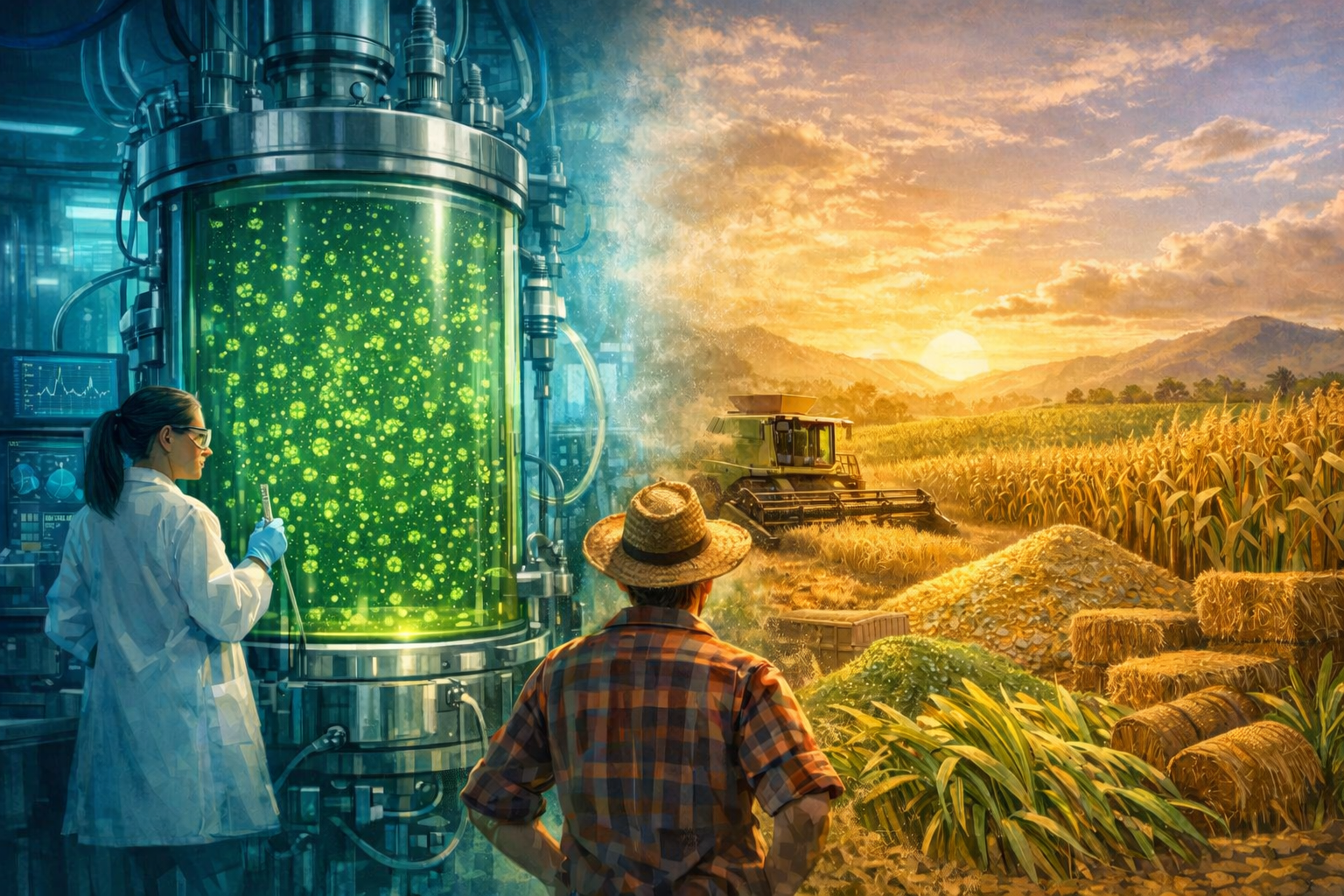
The hidden biology that feeds biotechnology
Modern biomanufacturing relies on controlling the biology inside the vessels. But even in engineered systems, living systems drift, as cells adapt, mutate, and behave differently across time and scale. Advances in strain engineering have dramatically expanded what biological systems can produce, improving yield, specificity, and theoretical performance.
The other biology in the system, the feedstock, comes before the organism and the reactor, and is never static. It operates on timescales of weeks or months, far from the reactor, and its composition shifts with geography, season, supply chain, and upstream processing. It carries variability, impurities, and signals that propagate through the system. This biology is not engineered in the same way.
Most modern biomanufacturing systems are built around a narrow set of highly standardized feedstocks, primarily glucose and dextrose, chosen for consistency and compatibility, not abundance or cost. At scale, the larger the deviation from the pure, controlled baseline, the more the system's assumptions start to show.
As the world changes more rapidly, the next generation of bioeconomy systems will increasingly rely on feedstocks that are more variable and less defined. Agricultural residues, food processing byproducts, and other heterogeneous streams are becoming increasingly sought after. These feedstocks introduce broader compositional ranges, inhibitors, contamination risk, and different preprocessing requirements to the system and do not fit neatly into the current precision fermentation paradigm.
One emerging direction is to move beyond systems optimized for ideal conditions and toward systems that incorporate variability into their design through mixed biomass, microbial communities, and alternative fermentation modes. These approaches trade tight control for resilience and represent a shift in perspective: from engineering a single biochemical pathway to engineering a dynamic biological system.
In this context, feedstock is no longer a constraint to be eliminated through standardization. Feedstock reality becomes a central design variable that changes how scale-up is approached. It allows both biologies to align with modern supply, operational, financial, and policy realities from the beginning, rather than correcting for them later.
This is the design problem we’re working on at Earthia.
