
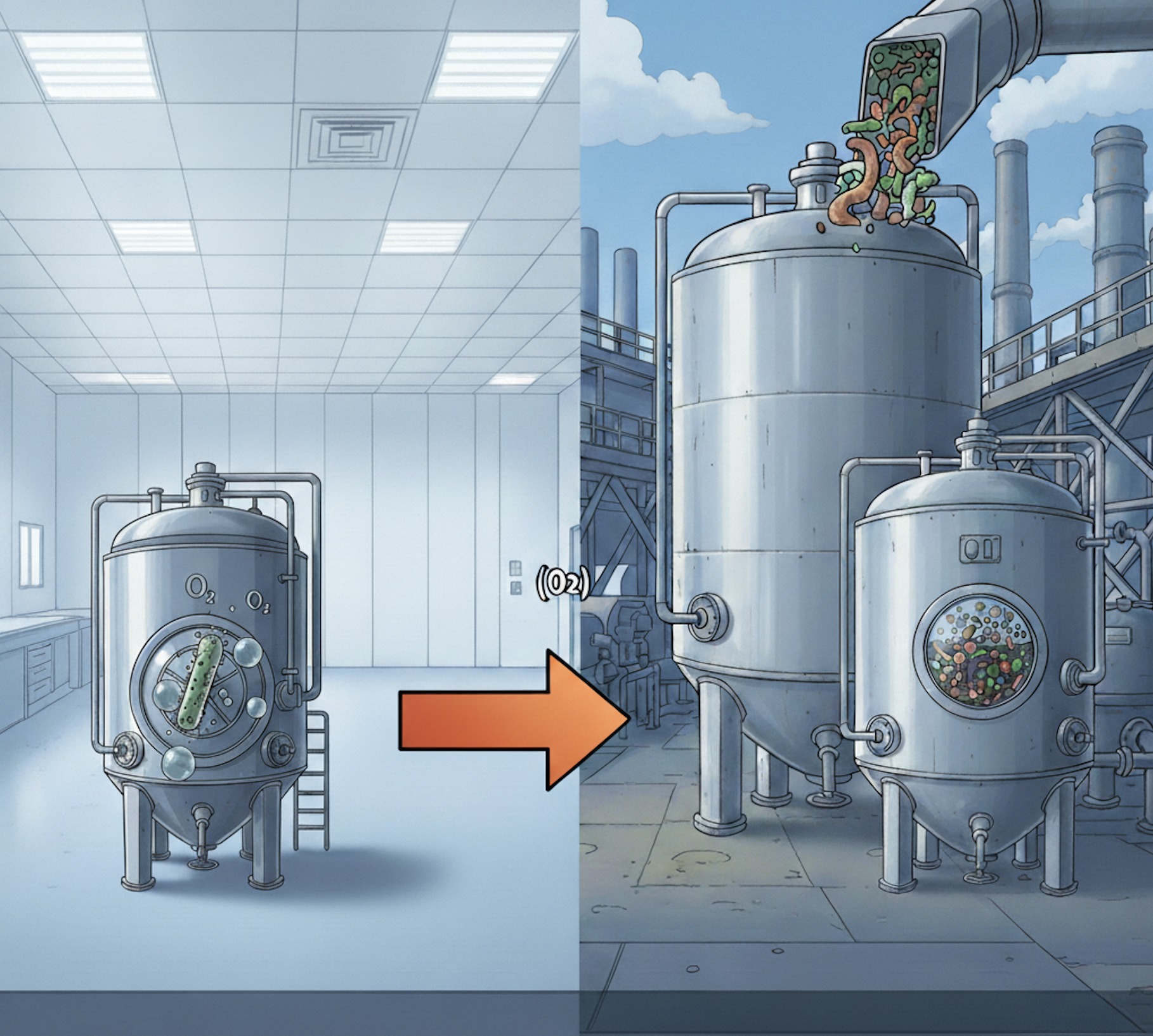
Oxygen Built the First Bioeconomy. Feedstock Will Build the Next.
Industrial biotechnology scaled by maximizing control optimized for yield: oxygen, refined sugars, sterility, and monocultures. That model worked for high-value therapeutics, even when oxygen transfer and mixing physics set hard limits at scale. This comes at a cost that commodity bio-based molecules cannot afford.
Meanwhile, the largest deployed biological infrastructure in the world has been operating in parallel: waste-processing systems running without purified sugars, without sterility, and without continuous oxygenation. This can open the door to new biomanufacturing innovations.
If carbon supply becomes the constraint, waste is no longer a disposal problem — it’s capacity. But unlike other feedstocks, waste is variable and heterogeneous. And the microbes transforming it into valuable products are an adaptable community that responds to this variability in the final product profile.
If single carbon, gas and strains defined productivity in the first era of the bioeconomy, the information embedded in feedstock variability will define productivity in the next.
The next competitive advantage won’t be strain engineering alone.
It will be feedstock intelligence.